I Asked If Free Could Pay For Itself. 59 Days Later, Here's the Number.
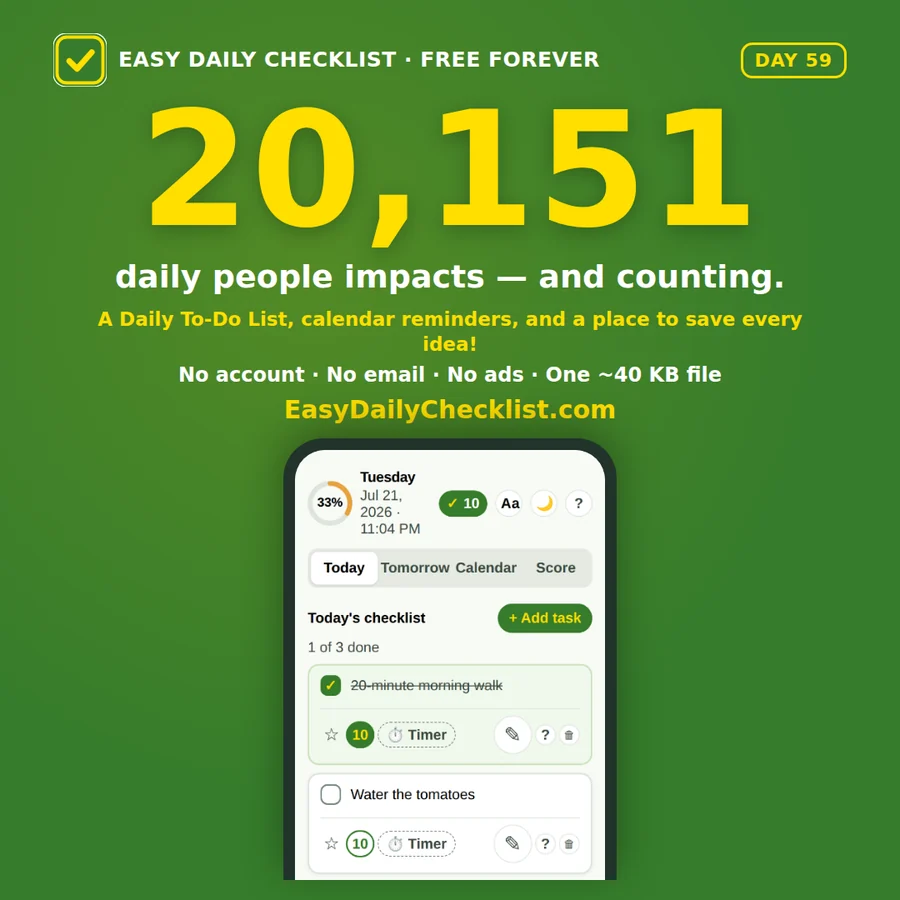
Back on July 4 I gave away an app and asked a question I couldn't answer: can something completely free pay for its own existence, purely on the goodwill of the people it helps?
I didn't know. That was the honest part. I'd spent almost forty years building funnels that ask for your name first, and I'd just built the opposite on purpose, and I had no idea whether it would work or whether I'd just spent twenty-six hours making a very nice gift for strangers.
Fifty-nine days have gone by. I've got a number now.
20,151 daily people impacts, and counting.
Let me tell you what that number is, what it isn't, and what it cost.
First, what the number actually counts
It counts days that a real person opened their list and did something with it. Not downloads. Not page views. Not "reach," which is a word people use when they don't want to tell you anything.
Roughly 340 a day, climbing. It sits right on the front of easydailychecklist.com where anybody can check my math, and it moves whether I'm watching or not.
Compared to Instagram, that's a rounding error on a rounding error. Compared to a guy in Nashville who got fed up on a Thursday night, it's twenty thousand mornings that went a little better than they would have. I'll take it.
Here's the part that still makes me laugh: I have no idea who any of those people are. Not one email address. Not one name. I built a thing that twenty thousand mornings ran through and I cannot send a single one of them a message.
That was the whole point. It still feels strange.
The chute and the trough
Let me explain what I actually did, because "no funnel" is too vague to be useful to you.
If you've never worked cattle, a chute is a fenced lane that starts out wide and friendly and gets narrower the farther in you walk. The cow doesn't know it's a chute. The cow sees an open gate and thinks, well now, this looks like a fine idea. By the time the walls close in, the cow has run out of options and opinions.
Now go download a free app.
The gate is wide open. FREE, in big friendly letters. You tap it. And about four screens in, the walls start moving. Create an account. Verify your email. Choose a plan — oh, you wanted the free one? Sure, it's right under this bigger, greener button. Seven days left in your trial. Three days left. Your trial has ended.
That's not an app. That's a chute.
And we've all gotten so used to walking through them that we don't feel the walls anymore. A grown adult will hand over their email address to see a checklist. A checklist! Imagine walking into a hardware store, picking up a $4 tape measure, and the fella behind the counter says, "Sure thing — first I'll need your email, your phone number, and permission to text you about tape measures forever."
You'd walk out. You know you would.
So I didn't build a chute. I built a trough. You don't herd cattle to water — you put out clean water and stand back. The ones that are thirsty come on their own, and they come calm.
The three rules I refused to break
Every temptation I've had in fifty-nine days has been a version of breaking one of these.
Nothing to sign up for. No account, no email, no name, no phone. Not "we won't spam you" — that's a promise, and promises are what you offer when you're holding something you could misuse. I didn't want to be trusted with your email. I wanted to never have it.
Your data never leaves your device. Your tasks and history live in your browser, on your machine. There's no server holding your stuff, because I never built one. Once a day the app asks the site for the day's quote and sponsor line, and that ping gets counted anonymously. I can see how many, never who. That's the entire telescope.
Free forever, the real kind. No premium tier. No trial. No "unlock more with Pro." There's a patron wall and a sponsor-a-day calendar for folks who want to chip in, both entirely voluntary. The app never asks. It never even brings it up.
And the one that turned into my favorite: the whole thing is one HTML file, about 40 KB. Download it, keep it forever, works with no internet at all. A typical habit app is a 50 to 200 megabyte install that stops working the day the company gets acquired.
Don't believe any of it? Hit View Source. That's not a marketing claim, it's a dare.
What fifty-nine days taught me that I didn't expect
People wanted to keep score. Three days after launch I was on a webinar with Dan Sullivan, one of the sharpest business coaches alive, and he talked about scoring his days — every task worth points, every day getting a number, his personal best being a 250. Twenty years of half-formed thinking clicked into place and I built it that night. Now every task can carry points and a Score tab rolls your days into weeks, months, and the year. Don't like numbers? Ignore them entirely and it's the same simple checklist it always was.
People needed somewhere to put ideas that weren't for today. So there's a Barn now. Jot the idea down and it sits off your list until its day comes, then you Harvest it onto any date you pick. Ideas are hay. Cut them when they're green, store them in the barn, feed them out when you need them.
People wanted edges around their work. Years ago at an event called Get Altitude, Eben Pagan taught one small thing that stuck: don't work on a task, work on a task for 50 minutes. When a job has no edges your brain treats it like a wet bar of soap — every time you grab it, it squirts off somewhere. So every task now carries its own countdown. I used to keep a physical timer on my desk, but the darn thing had legs and kept wandering off to sit next to a paint can. I was running a retirement home for lost timers. Now it lives on the task, where it can't walk away.
None of those were on a roadmap. They came from using the thing and from people writing to me on the porch. A user named Scott emailed about dragging tasks to reorder them, and that's in the app now because Scott took two minutes to write a stranger. Somewhere out there, Scott is using a feature he invented.
That's what happens when there's no funnel in the way. The feedback that reaches you is about the product instead of about the price.
So did it pay for itself?
Not in dollars. Let's be honest about that. The patron wall and the sponsor days are small and beside the point.
Here's what it paid instead, and I say this as a man who has built a lot of funnels:
Trust is an asset, and it does not show up on the day you build it.
Twenty thousand mornings' worth of people now know something about me. They know I'll build something useful. They know I won't hold their email hostage to hand it over. They know that when I say free, I mean free — not "free," with the little quote marks doing the heavy lifting.
You cannot buy that. You cannot ad-spend your way to it. And you sure as heck cannot get it by putting a gate in front of a checklist.
The test, if you're sitting on something you could give away
I'm not telling you to work for free. I'm telling you something narrower.
If you're going to give something away, give it away.
The half-gift is worse than no gift. A "free download" that costs an email address isn't free — it's a trade with the price hidden in the fine print, and your customer knows it. They've been through that chute a hundred times. They can smell the walls before they walk in. Every time you do it you spend a little trust to buy a little data, and trust costs more than the data is worth.
So pick one. Sell it honestly, or give it away honestly. What stopped working — right around the time everybody got tired — is dressing up a toll booth as a gift.
Here's the question I use now on anything I'm about to publish:
Would this still be worth making if nobody ever bought anything from me?
If yes, put it out clean. No gate, no chute, no "just enter your email." Let it go do its work, and let the people it helps decide what happens next.
Fifty-nine days in, I can tell you what happens next. People show up. They tell their friends. They write to you on the porch. And every one of them knows exactly what kind of outfit you run — because you showed them instead of telling them.
The good guys and gals who actually make the world go round deserve tools that don't pick their pockets on the way in. That's what putting the free in freedom was ever supposed to mean.
Go use it
easydailychecklist.com. The app at the top of that page is the real thing, not a demo. Nothing to sign up for.
Then do the one thing that makes it work: decide what tomorrow looks like tonight. Open the Tomorrow tab before you shut down, write the three to five things that matter, and hit those first in the morning — before the squirrels and shiny objects show up.
Your number today determines your tomorrow.
Cheers,
Andrew Easy Anderson
Is Easy Daily Checklist really free?
Yes. Free forever, for everyone. No premium tier, no trial that expires, no "unlock more with Pro." A voluntary patron wall and sponsor-a-day calendar exist for people who want to chip in, but the app itself never asks.
Do I need an account or an email address to use it?
No. There is nothing to sign up for and no email to enter. You open the page and start using it. That is the entire onboarding.
Where is my checklist data stored?
On your own device, in your browser. Your tasks and history are never uploaded. Once a day the app requests the day's quote and sponsor line, and that request is counted anonymously. It shows how many people the app helped, never who they are.
What is an anti-funnel?
A giveaway with no capture mechanism attached: no email gate, no account requirement, no trial timer, no upgrade path built into the product. The visitor gets the full thing immediately and is free to leave with it. The return comes from trust and word of mouth rather than a captured contact list.
Does giving something away with no email capture actually work?
It works differently than a funnel does. It produces no list and no immediate leads, so it cannot be measured on a weekly dashboard. What it builds is trust, which shows up later and from unexpected directions. Easy Daily Checklist recorded 20,151 daily people impacts in its first 59 days with no ad spend, no launch list, and no email capture at all.
How big is the app?
One HTML file, roughly 40 KB. Download it, save it anywhere, and open it with no internet connection.