I Tried to Fix Google Keep. I Built an App Instead.
I've spent almost 40 years working with mainframes, building forums, and building funnels. Squeeze pages, video sales letters (I originated one of those), campaigns that generated an estimated $2.5 billion in leads for clients. Every single one of them started the same way: give me your name and phone number — then we added email — and I'll give you the thing.
Last Thursday, July 2nd, 2026 my day started at 4 AM, the way most of mine do. At exactly 7:07 PM, 15 hours later, I got tired of having the same problem for the last time — and started building the opposite. Not by accident. On purpose, because I was fed up with how things were done.
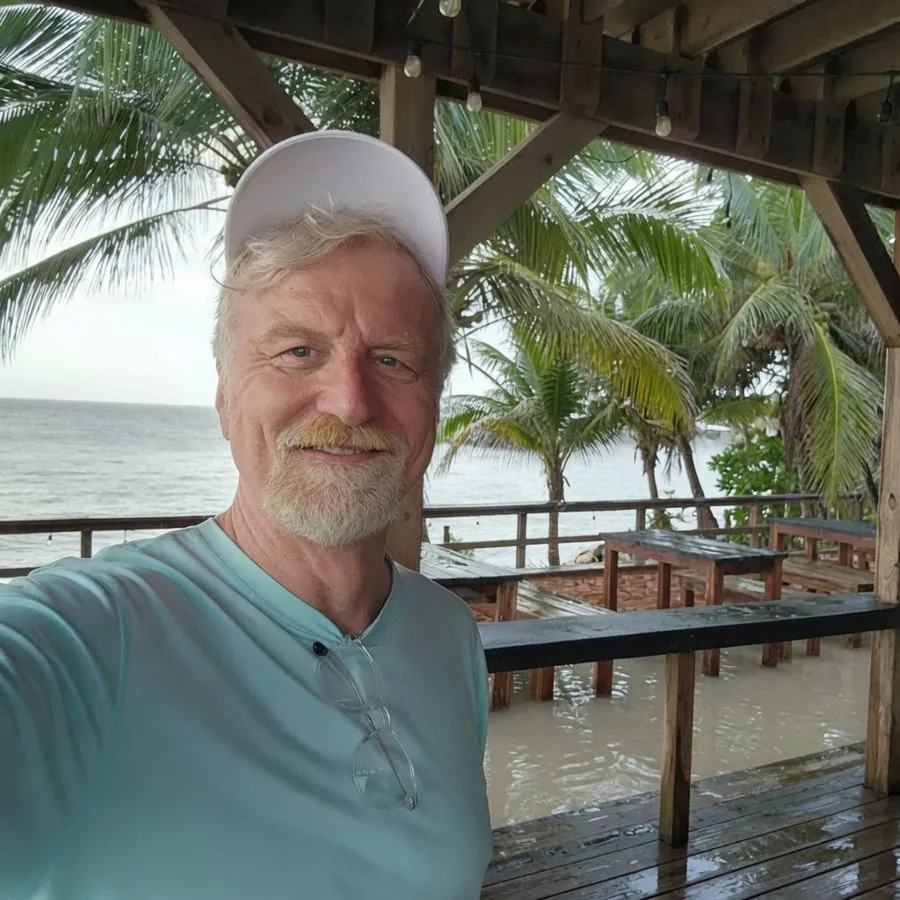
It started with a scrap-of-paper problem
I was one of the early kids they slapped the ADHD label on. I've come to believe it's less a disorder and more what happens to curious little boys who won't stop asking why... and honestly, I think it's a superpower. My brain has always seen how A connects to B connects to Z and back to M. It made me the kid who could fix the tractor and build the homecoming float.
What it did not make me was organized.
My whole life I've bought notepads with the sincere belief that this one — this one right here — would fix everything. An idea would hit, I'd scribble it on whatever piece of paper was closest, and then I'd spend the next day looking for the paper. (Post-it notes hadn't even been invented yet when this started. That's how far back the habit goes.)
The one thing that ever actually worked for a brain like mine: decide the night before. Write down the three, four, five things that matter. Get up and hit those first, before the squirrels and shiny objects show up. When I do that, my day goes right. When I don't, it doesn't.
Wyatt Woodsmall said something I've never forgotten (I heard him say it in person):
"Once you have enough information, there are no decisions to make."
Wyatt Woodsmall
That's the whole system in one sentence. The night-before list is gathering enough information that the morning has no decisions left in it.
So I sat down with Claude to fix Google Keep
That was the plan, anyway. Wrestle Google Keep into being a proper checklist. My actual first message to the AI — "I'm, uh" included — is below. It's not impressive. That's the point.
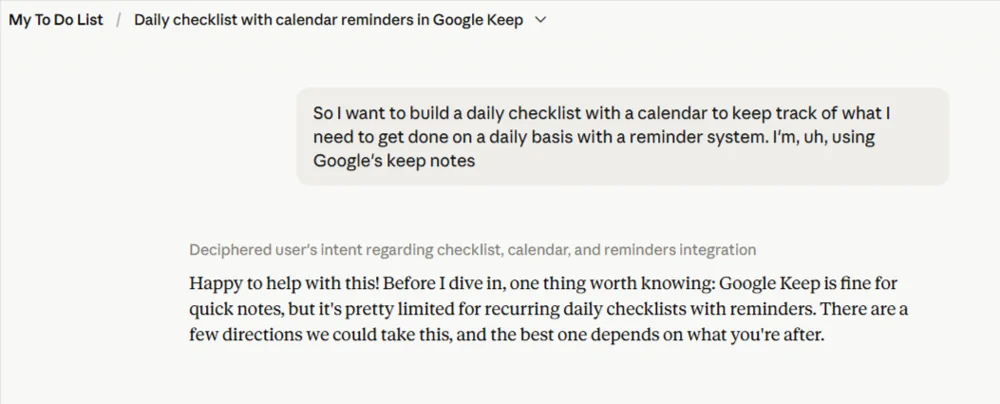
The first outline of the app was done in that first sitting. Then I worked seven hours straight, slept five, and went right back at it for nineteen hours straight to get everything ready for the real world. One HTML file. A checklist, reminders, a streak, a ring that fills up when you finish your day. Nothing else.
- Done: Thu, July 2, 2026, 7:07 PM — tried to fix Google Keep. Built an app instead.
- Done: Fri, July 3 — bought easydailychecklist.com mid-brainstorm. Business plan done by 9 AM.
- Done: Sat, July 4, 2026 — gave it away. Free forever. (America's 250th birthday. Total coincidence. Or was it? It was.)
- 4. See how many people it helps — counting has begun.
Here's the part that should get your attention
I keep telling people the same thing: with every previous technology wave, I was 5 to 10 years early. Websites in the 80s. Voice recognition before anyone wanted it. With AI, I'm only about six months ahead of you — and this is what six months ahead looks like.
A working, shipped, WCAG-verified product. Twenty-six hours of work, start to finish. By one guy and an AI.
Not a prototype. Not a demo. A real thing real people are using, with verified quotes (the internet gets a shocking number of famous quotes wrong — half of what's blamed on Churchill was never said by him), a privacy model where your data never leaves your device, and one quiet sponsor line that pays the bills.
That's not a story about me being special. That's a story about the tools being ready. If a checklist app takes twenty-six hours, ask yourself what the AI-shaped hole in your business would take.
Ben Franklin beat me to it by 300 years
The daily checklist wasn't invented by an app company. In 1726, Benjamin Franklin ruled a little notebook into a chart — his thirteen virtues down the side, days of the week across the top — and marked it every single day. He even had a morning question and an evening one:
"What good shall I do this day?"
"What good have I done today?"
— Benjamin Franklin, 1726
The app is the 300-years-later version. Franklin's morning question owns January 1st in the quote slot, every year, forever.
The experiment inside the experiment
After four decades of asking for the name and phone number and then email first, I built something that asks for nothing. No account. No pixel. No popup. Then I asked a question that's been bugging me for years: can something completely free pay for its own existence purely on the goodwill of the people it helps?
The thing of it is, it has already paid me back and will continue to do so — I now get hours back every week I use it. Multiply that by the time saved by my team and our clients, and adding it all up, it will be a 100x savings over the next 12 months. And it will keep paying dividends every single day.
The rest of the story — the verified-quotes obsession, the sponsor model, the fine print that's actually the whole point — is over on the app's About page.
Go read it. Better yet, use the app tomorrow morning. It's free, and it'll stay that way.
And if you're wondering what twenty-six hours with AI and 40 years of problem-solving experience could do for your business... that's a conversation I'd enjoy having.
Cheers,
Andrew Easy Anderson
Why build an app instead of just using Google Keep?
Keep didn't handle the way a daily checklist needed to reset and repeat. Building it from scratch was faster than working around it.
How long did it take?
About 26 hours start to finish, beginning with a 4 AM start.
Is Easy Daily Checklist free?
Yes, free at easydailychecklist.com.